
Why The First Five Years Matter Most For Early Intervention

Updated: May 6
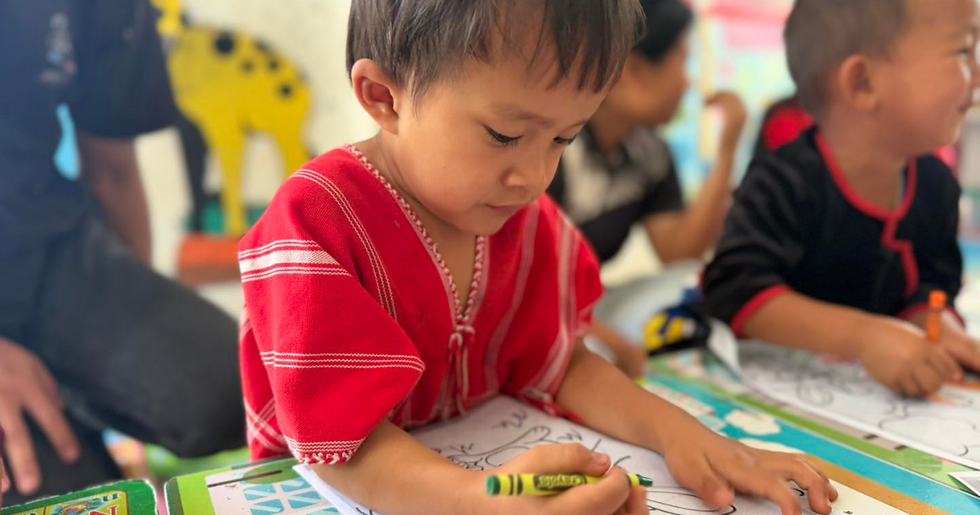
Early intervention is structured support for children with developmental disabilities delivered during the first years of life, when the brain is most plastic and most capable of being shaped by experience. The evidence is among the most consistent in developmental science: intervening early produces disproportionately large returns. Intervening late does not produce the same returns at greater cost — it produces different, and smaller, returns that no amount of subsequent effort can fully recover.
If a child is going to receive support for a developmental disability, the single factor that most reliably determines how much that support will help is when it begins. Not which programme. Not which therapist. Not which facility. When.
This article explains why, what the neuroscience behind it shows, and what it means for families in Northern Thailand navigating a system where early contact with specialist services is far from guaranteed.
The Dulabhatorn Foundation has been delivering early intervention and therapy programmes in Sansai District, Chiang Mai since 2007 — including occupational therapy, physical therapy, alternative communication (AAC) intervention, hydrotherapy, DohsaHou therapy, equine therapy, and adaptive climbing — all free to participants.
What the Developing Brain Makes Possible
At birth, a human brain contains roughly 85 billion neurons. In the first three years of life, the number of synaptic connections between those neurons grows from approximately 2,500 per neuron to 15,000 — an explosion of connectivity that represents the brain's maximum period of plasticity, its greatest capacity to be shaped by experience and intervention.
Research published in Frontiers in Public Health is direct: the first three years of life are when the brain is most plastic — most capable of changing and adapting through experience. Early environmental influences significantly shape brain architecture in ways that compound across development. What happens in these years does not just affect early childhood. It affects cognitive development, academic performance, social functioning, and long-term health outcomes across the entire lifespan.
LEARN Behavioral's review of neuroplasticity research adds a specific detail that matters enormously for early intervention: the young child's brain contains approximately 50% more neural connections than the adult brain. During adolescence, the brain undergoes significant pruning — cutting back connections that have not been regularly used. Neural pathways that have been exercised through early intervention survive that pruning. Pathways that have never been stimulated are more vulnerable to being cut.
This is the biological mechanism behind the timing effect. Early intervention does not simply accelerate development — it shapes which neural pathways become established, and therefore which capabilities become available for the rest of the child's life.

What the Research on Early Intervention Outcomes Shows
A 2024 annual research review in the Journal of Child Psychology and Psychiatry, examining early intervention through the lens of developmental neuroscience, found that interventions implemented earlier in childhood consistently produce larger effect sizes and better outcomes than those implemented later. This finding holds across disability types, intervention approaches, and cultural contexts.
A PMC narrative review of early interventions for autism spectrum disorder found that interventions initiated before age five — particularly between 18 and 36 months — yield significantly greater outcomes in cognition, language, adaptive behaviour, and social communication than those initiated later. The primary mechanism is exactly what the neuroscience predicts: early intervention leverages the brain's heightened plasticity during the critical period of early neurodevelopment, optimising the child's developmental trajectory before the pruning process begins to close windows.
A systematic umbrella review published in BMC Medicine, drawing on a decade of meta-analyses covering children under five with developmental disabilities, confirmed that early detection and rehabilitation interventions produce consistent improvements in child functioning across cerebral palsy, autism, intellectual disability, and developmental delay. The review noted that the regions with the highest burden of childhood developmental disability — which includes Southeast Asia — are also the regions where access to early intervention is most constrained.
A ScienceDirect review of early intervention principles describes this as the neuroprotective function of early intervention: stimulating brain development during the period of highest plasticity not only builds capacity but protects against further developmental divergence. The earlier the intervention, the more of the developmental window it captures. The later the intervention, the more of that window has already closed.
What This Means for Children in Northern Thailand
The implications of the timing evidence are particularly significant in contexts where the pathway from a family's first concern about their child to actual specialist contact is long and obstructed.
The barriers between a family in a rural district and a specialist service in Chiang Mai are substantial — transport costs, unfamiliarity with the registration system, and the absence of community-based referral pathways. Many children with developmental disabilities in Sansai District and surrounding villages do not reach any specialist programme until they are school age or older.
For a child with cerebral palsy, that delay may mean years of motor development happening without the structured therapy input that early intervention provides — years during which neural pathways for movement either develop through supported experience or develop less fully without it. For a child with autism spectrum disorder, that delay may mean the 18-to-36-month window of maximum language and social communication plasticity passing without targeted intervention. For a child with Down syndrome or intellectual disability, that delay may mean cognitive and adaptive development proceeding without the structured environmental enrichment that the early plasticity window makes most productive.
None of this is the family's fault. The barriers are real. But understanding what the evidence says about timing changes how urgently those barriers need to be addressed — and why outreach programmes that go to families rather than waiting for families to come matter as much as the programmes themselves.
What Early Intervention Looks Like in Practice
The research is clear that early intervention does not require sophisticated facilities or expensive equipment. A PMC review of early intervention approaches in low- and middle-income countries found that the most critical elements are responsive parenting, stimulation of infant development, and caregiver capacity building — all of which can be delivered in community and home settings by trained practitioners.
Parent-mediated intervention — where practitioners coach parents to deliver therapeutic interaction in daily routines — is consistently found to be effective and accessible. A PMC review of telehealth-delivered early intervention found meaningful improvements in language and adaptive behaviour from parent-coaching models delivering as few as 1.5 hours per week of practitioner contact. The mechanism is the daily dose of interaction between parent and child — the singing, the responding, the play — guided by a practitioner who understands the child's developmental profile and the family's context.
This means early intervention is not primarily a question of clinic access. It is a question of reaching families early enough, with enough information and support, to change how they interact with their child in the years when that interaction shapes the brain most profoundly. It connects directly to DBF's broader capability-building philosophy — building lasting capacity in the child and the caregiver, not dependency on a programme.
What DBF's Early Intervention Work Addresses
The Dulabhatorn Foundation's programmes span the full developmental range — from early intervention for young children through school-aged programmes and vocational exploration for young adults. The early intervention work exists precisely because the evidence on timing is so clear: reaching families with young children, in their communities, before the developmental window narrows, is among the highest-leverage things a disability organisation in Northern Thailand can do.
Community outreach — home visits to families in villages across Sansai District — is one expression of this. Waiting for families to navigate the system to DBF means waiting too long for some children. Going to the families means meeting the child where they are, at the age when it matters most.
The therapy programmes DBF delivers — occupational therapy, physical therapy, alternative communication (AAC) intervention, hydrotherapy, DohsaHou, equine therapy, and adaptive climbing — are most effective when a child reaches them early. Each of these therapies works with the brain's plasticity, not against it. The earlier a child begins, the more of the developmental window those therapies can capture. And the outcomes from early therapy investment carry forward — into school, into the vocational exploration years, and into the longer-term independence that DBF's programmes exist to support.
Frequently Asked Questions About Early Intervention
What is early intervention for children with disabilities? Early intervention is structured support — therapy, caregiver coaching, developmental stimulation — delivered to children with disabilities or developmental delays during the first years of life. It is timed to coincide with the brain's maximum period of plasticity, when experience and therapeutic input have the greatest and most lasting effect on development.
Why do the first five years matter so much for development? In the first three years of life, the number of synaptic connections in the brain grows from around 2,500 per neuron to 15,000. This is the brain's peak period of plasticity — its greatest capacity to be shaped by experience. During adolescence, the brain prunes connections that have not been regularly used. Neural pathways built through early intervention survive that pruning. Those that were never stimulated are more vulnerable to being lost.
What does the research say about early intervention outcomes? The evidence is consistent across disability types and cultural contexts. Interventions initiated earlier produce larger improvements in cognition, language, motor function, and adaptive behaviour than those initiated later. For children with autism spectrum disorder, interventions begun between 18 and 36 months yield significantly greater outcomes than those begun at school age. For children with cerebral palsy, early physiotherapy and therapy input shapes motor development during the period when the brain is most responsive to it.
What does early intervention look like in practice? Early intervention does not require a clinic or specialist equipment. The most critical elements — responsive parenting, developmental stimulation, caregiver coaching — can be delivered in community and home settings. Parent-mediated models, where a practitioner coaches parents to deliver therapeutic interaction in daily routines, are effective with as few as 1.5 hours of practitioner contact per week. The daily dose of guided interaction between parent and child is what drives outcomes.
Is early intervention available in Chiang Mai? Yes. The Dulabhatorn Foundation in Sansai, Chiang Mai delivers early intervention and therapy programmes for children with developmental disabilities, including outreach to families in surrounding villages. All programmes are free to participants. Contact the team to discuss your child's situation or to make a referral.
Who can refer a child to DBF for early intervention? Families, paediatricians, hospital social workers, village health volunteers, and community workers can all make contact with DBF directly. The foundation welcomes referrals from anyone working with or supporting families in Northern Thailand who have a young child with a developmental disability or a concern about their child's development.
If you have a young child whose development concerns you, or if you are a paediatrician, hospital social worker, or village health volunteer working with families in Northern Thailand, the Dulabhatorn Foundation's team can speak with you directly. Contact us at contact@dulabhatornfoundation.com or call +66 (0) 53 350 303. DBF has been supporting children and young people with disabilities in Sansai District, Chiang Mai since 2007. All programmes are free to participants.
To support DBF's early intervention work, visit dulabhatornfoundation.com/support-us.


Comments