
Boeing and DBF: Fourteen Years of Possibility
Since 2011, Boeing has partnered with the Dulabhatorn Foundation through its Boeing Global Engagement (BGE) program, supporting seven consecutive projects that have extended therapy, education, and vocational exploration to children and young people with disabilities across Chiang Mai and the surrounding highlands.The partnership began with a shared conviction: that children with disabilities in Northern Thailand, particularly those from highland and rural communities, deserve access to the same opportunities as their peers. Over fourteen years, that conviction has shaped real outcomes for hundreds of children and their families.
DBF is listed as a current grant partner on the Boeing Southeast Asia Thailand page, alongside organizations working in STEM education, clean water access, and migrant community support. The foundation is grateful for Boeing's continued commitment.


What the Partnership Has Built
From the Highlands to the Clinic
The earliest CIC phase (2011 to 2014) reached six highland villages, establishing public health infrastructure and providing the first scholarships to children who would otherwise have had no route into formal support. Fifty-seven children with special needs received support during this period, many of them from Karen and other highland communities with limited access to services in Chiang Mai.
Finding the Lost and Forgotten
The 2014 Lost and Forgotten project named something that had not previously been named: that children with disabilities in highland areas were not simply underserved but had effectively disappeared from the system entirely. The project introduced occupational, physical, and speech therapy to approximately 130 children, along with equine therapy for 50 participants. The outcomes documented at the time, including increased self-confidence and stronger integration into family and community life, laid the foundation for everything that followed.
Building a Place to Learn and Work
The Putting Principles into Practice phase (2015 to 2016) established the structures that now define DBF's approach: the DBF Cafe and the organic farm. These are not peripheral facilities. They are the vocational exploration environment where the children DBF supports develop practical skills in food preparation, customer service, horticulture, and sustainable agriculture. The Cafe is open to the public. The farm supplies the Cafe. Both exist because Boeing helped make them possible.
Training the Community to See
LINKS (2016 to 2018) recognised that DBF alone could not reach every child who needed support. The solution was to train the people already embedded in communities: 130 teachers learned to identify children showing signs of developmental delay, and 65 community health volunteers were equipped to provide follow-up support in remote villages. Eleven organisations joined a network designed to sustain that reach beyond the project period.
A Person-Centered Approach
The 2019 to 2021 PCA project shifted the focus to individual pathways. Rather than a uniform program, each young adult worked toward goals shaped by their own strengths and interests. Five participants gained skills that led directly to paid employment. One graduate, Tirapit Ruanpang, joined the staff of a local hospital, supporting patients in physical therapy and handling administrative responsibilities. His story is one of several that demonstrate what sustained, individualised support can produce.
Growing Something That Lasts
The most recent phase, ISMD (2022 to 2024), trained 20 people with disabilities and their family members in sustainable agriculture. The aim was not simply to teach skills but to create household self-sufficiency that persists after the project closes. Seven collaborating organisations provided additional employment pathways or contributed to the knowledge-sharing network.
What Comes Next: Garden Pathways for All (2025 to 2027)
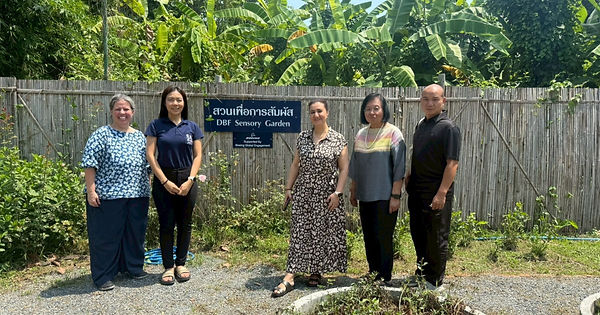
The seventh phase of the Boeing partnership is now underway. Garden Pathways for All focuses on inclusive garden initiatives as a framework for therapeutic and vocational exploration. The project aims to benefit 60 school-aged children, 20 young people with complex multiple disabilities, and 25 young adults working toward specific job and social skills through garden-based activities.
The garden model is deliberately accessible. It works across ability levels, connects to DBF's existing organic farm infrastructure, and creates natural opportunities for community participation and family involvement.
The Scale of What Has Been Achieved
Across fourteen years and seven project phases, the Boeing partnership has contributed to outcomes that span public health, family economics, therapeutic access, and employment.
-
Two public health centers built, serving approximately 788 people
-
Four community water taps installed, serving approximately 845 people
-
Specialized therapy (occupational, physical, speech, equine) introduced to approximately 130 children who had no prior access
-
130 teachers trained in developmental screening techniques
-
65 community health volunteers equipped to identify and support children in remote villages
-
11 organisations networked to sustain coordinated support
-
20 people with disabilities and their families trained in sustainable agriculture
-
Five young adults progressed to paid employment through the Person-Centered Approach project
-
The DBF Cafe and organic farm established as permanent vocational exploration environments, alongside a Parent and Caregiver Club providing space for families to collaborate on income-generating projects and display goods for sale at events
Boeing's Commitment to Thailand
Boeing's relationship with Thailand extends across commercial aviation, defense, and community investment. On the community side, the company's 2024 grant partners in Thailand include DBF alongside the Kenan Foundation Asia, World Vision Foundation of Thailand, and The Asia Foundation. The full list is published on the Boeing Southeast Asia Thailand page at boeing-sea.com.
DBF's work aligns with Boeing's stated community engagement priorities: education, workforce development, and community resilience. For DBF, the partnership has meant the difference between programs that could be imagined and programs that could be built.
Support DBF's Work
Boeing's partnership makes programs possible. Individual and institutional donors sustain them. DBF operates a private endowment that covers all administrative costs, which means every donation goes directly to children's programs.
If you would like to support the work Boeing has helped build, visit the support page or contact the foundation at contact@dulabhatornfoundation.com.


