
How Horse Therapy Helps Children With Disabilities And Why A Horse Does What No Other Therapy Can

Updated: May 6

Equine-assisted therapy is a structured clinical intervention that uses the movement and presence of a horse to improve motor function, balance, sensory processing, and social engagement in children with disabilities. It is used with children with cerebral palsy, autism spectrum disorder, Down syndrome, and a range of other developmental and physical conditions — and it produces outcomes that no piece of equipment, no pool, and no climbing wall can replicate.
There is a moment that therapists and parents describe consistently across research studies, clinical reports, and first-person accounts: a child who resists touch, avoids eye contact, and struggles to communicate with people voluntarily reaches out to touch a horse. Something shifts. That shift is not sentimental — it has a physiological explanation, a growing body of peer-reviewed evidence behind it, and practical implications for how disability therapy programmes are designed.
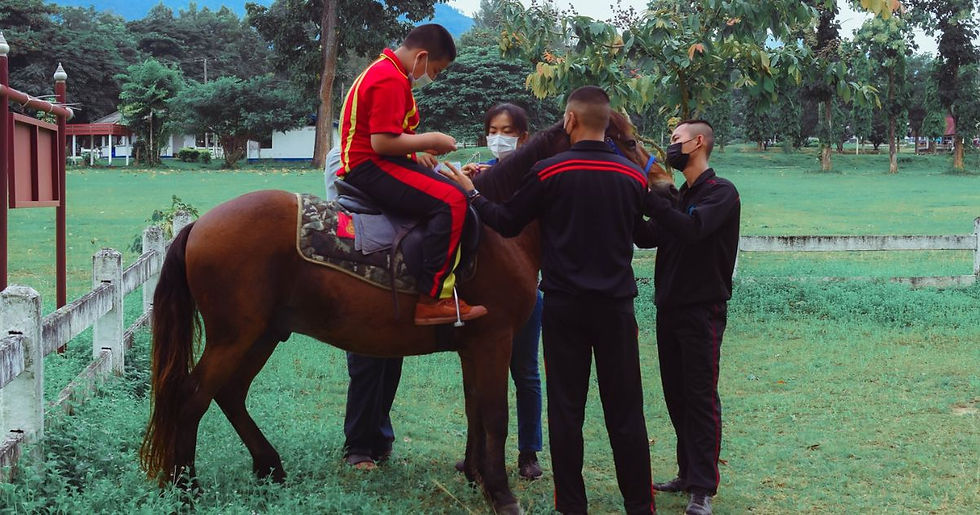
The Dulabhatorn Foundation includes equine-assisted therapy through its partnership with El Caballo Horse Riding Club as part of a wider therapy model that includes occupational therapy, physical therapy, alternative communication (AAC) intervention, hydrotherapy, DohsaHou, and adaptive climbing.
What Horse Therapy Is — And the Important Distinctions Within It
Equine-assisted therapy is not a single approach. The term covers a spectrum of structured interventions involving horses, and the distinctions matter for understanding what the research is actually measuring.
Hippotherapy is the most clinically specific form. The term comes from the Greek hippos meaning horse. In hippotherapy, a licensed occupational therapist, physiotherapist, or speech and language pathologist uses the horse's movement as a therapeutic tool — not by teaching riding skills, but by positioning the client on the horse and allowing the animal's characteristic three-dimensional gait to deliver sensory and neuromotor input that the therapist cannot produce any other way. The client does not control the horse. The therapist does, while guiding the client's posture, responses, and engagement.
Therapeutic horseback riding takes a different approach: the client learns riding skills under a certified instructor, and the physical, cognitive, emotional, and social demands of that learning process produce therapeutic outcomes. Sessions typically involve both mounted and ground-based activities — grooming, leading, stable work — each of which carries its own therapeutic dimension.
Equine-assisted psychotherapy does not involve riding at all. It uses ground-based interaction with horses — observation, grooming, feeding, leading — within a structured psychological framework, with a mental health professional present. The horse serves as a mirror and a catalyst for emotional and relational work rather than a physical therapy tool.
All three share one thing: the horse itself, and the specific qualities only a horse brings to the therapeutic encounter.

What the Horse Actually Does — The Neuroscience of Equine Movement
Why does a horse work when other animals do not? The answer lies partly in physics and partly in neurology.
A walking horse produces a three-dimensional pelvic movement that closely mimics the movement of the human pelvis during typical walking. Researchers have described this as the horse effectively acting as the client's cerebellum — the part of the brain responsible for posture, balance, and coordination. For children with cerebral palsy, whose postural control is compromised by neurological damage, sitting on a walking horse provides thousands of repetitions of that pelvic movement pattern within a single session, in a context that is functional and motivating rather than clinical and repetitive.
This matters because the neurological benefits of movement depend heavily on repetition and context. The horse's variable gait — the constant small adjustments in direction, speed, and rhythm — requires the rider to continuously adapt their postural responses, creating what researchers call massed and random practice of balance reactions in a real and meaningful activity rather than an exercise routine.
For children on the autism spectrum, the neurological mechanism is different but equally specific. Cerebellar abnormalities are common in autism, and the cerebellum is implicated in motor, sensory, and social functioning. Researchers have proposed that the motor learning demands of horseback riding — remaining balanced on a moving animal — directly stimulate cerebellar function, and that improvements in motor and postural control subsequently generalise to improvements in sensory processing and social engagement.
Beyond neurology, the horse creates a sensory environment that is rich in exactly the kinds of input many children with disabilities need: proprioceptive feedback through the movement of riding, tactile input through grooming and contact, vestibular stimulation through rhythm, and auditory and olfactory input from the stable environment. For children with sensory processing differences, this multi-sensory immersion can produce a calming and organising effect that is difficult to achieve in clinical settings.

What the Research Shows for Children With Cerebral Palsy
Cerebral palsy is where equine-assisted therapy has the longest research history and the most developed evidence base.
A 2024 systematic review published in the Italian Journal of Pediatrics, reviewing ten studies of children aged two to fourteen, found consistent improvements across gross motor function, balance, coordination, gait parameters, and muscle strength following hippotherapy programmes. The review concluded that hippotherapy can improve motor function skills as a standalone treatment or as a complement to other therapies.
A systematic review and meta-analysis published in Children analysing ten randomised controlled trials involving 452 participants found favourable effects of hippotherapy on gross motor function measured by the standard clinical instruments used in cerebral palsy rehabilitation.
A January 2025 review in the Journal of Clinical Medicine, covering studies published between 2012 and 2022, confirmed that both conventional hippotherapy and horse-riding simulators produce promising results on gross motor function, and documented a consistent pattern across studies of improvements in postural control and trunk stability.
The evidence is strong for gross motor function, postural control, and balance, and more variable for other outcomes. Larger randomised trials with standardised protocols would strengthen the evidence base further. But the consistency of findings across decades and across populations is sufficient to justify hippotherapy's place in a disability therapy programme — and its combination with other therapies like hydrotherapy and early intervention can extend those outcomes further.
What the Research Shows for Children With Autism
The autism evidence base is newer but the direction is clear.
A 2023 systematic review and meta-analysis published in the International Journal of Environmental Research and Public Health, covering 25 studies, found that equine-assisted activities and therapies substantially improve social and behavioural skills in children with autism. Hippotherapy exercises showed beneficial effects on postural control, interpersonal relationships, and adaptive behaviours. The rhythmic movements of horseback riding were found across multiple studies to activate vestibular systems in ways that enhance speech production and improve learning outcomes.
A 2024 study published in Children, following 86 children with varying autism severity levels through 20 weekly sessions, found meaningful improvements in adaptive behaviour across severity levels, with children with more complex presentations showing notable responses to the structured equine-assisted programme. Parental stress also showed indicators of improvement alongside child outcomes — a finding that matters because the families of children with disabilities carry their own significant burden.
A systematic review published in Frontiers in Veterinary Science noted that therapeutic horseback riding ameliorates sensory sensitivities, enhances social motivation, and diminishes stereotypical behaviours in children with autism. Social communication and sensory processing capabilities showed improvement during intervention periods, with some benefits persisting into follow-up.
For autism, the horse matters not just as a movement tool but as a relational catalyst. Horses are highly sensitive to human emotional states and respond to body language in ways that are immediate and honest. For children who find human social interaction overwhelming, the horse offers a simpler, more predictable form of relational feedback — one where communication through posture, tone, and movement produces a direct and non-judgmental response.
What the Research Shows for Children With Down Syndrome
For children with Down syndrome, equine-assisted therapy addresses several of the most common physical and developmental challenges associated with the condition: low muscle tone, reduced postural stability, and limited balance and coordination.
The three-dimensional movement of the horse's gait provides continuous postural challenge and proprioceptive input, which is particularly valuable for children whose hypotonia makes maintaining posture effortful on land. Research on hippotherapy in children with Down syndrome has documented improvements in postural control and trunk stability — outcomes that carry over into daily functioning, from sitting and standing to participation in other therapy activities.
The relational and sensory dimensions of horse therapy also align well with the developmental priorities of many children with Down syndrome. The structured, predictable environment of a session, combined with the warmth of the horse and the consistency of the therapeutic relationship, builds confidence and communication skills that generalise beyond the stable. For children also receiving DohsaHou therapy, the combination of equine movement work and guided psychological relaxation can address both the physical and emotional dimensions of development simultaneously.
What Makes Horse Therapy Different From Everything Else
Each therapy in DBF's programme addresses different layers of a child's development through genuinely different mechanisms. Occupational therapy builds the functional skills of daily life. Physical therapy develops movement, strength, and motor function. Alternative communication (AAC) intervention opens channels of expression for children who cannot yet use speech. Hydrotherapy uses water's physical properties to enable movement in children whose muscle tone or physical capacity limits what land-based therapy can achieve. DohsaHou targets the psychological dimension of tension and movement through guided contact with a therapist. Adaptive climbing creates a cognitively and physically demanding challenge that builds confidence through mastery.
Horse therapy does something that none of these replicate: it creates a living, breathing, emotionally responsive relationship within the therapeutic encounter. The horse is not a piece of equipment. It is an animal with its own temperament, its own responses, and its own form of attention. For children who find human relationships overwhelming and clinical environments sterile, that quality is genuinely distinct.
Research from Sage Journals examining motor outcomes for autistic children confirmed significant improvements in coordination, strength, balance, posture, and overall motor skills across equine-assisted service programmes. That it also reduces parental stress is a reminder that supporting a child with disabilities is never only about the child — it is about the whole family, and any intervention that lightens that load has value that extends well beyond the session itself. This is central to DBF's capability-building philosophy: building strength and confidence across the family unit, not just within the individual programme.
Frequently Asked Questions About Horse Therapy for Children
What is horse therapy for children with disabilities? Horse therapy — also called equine-assisted therapy or hippotherapy — is a structured clinical intervention that uses the movement and presence of a horse to produce therapeutic outcomes in children with disabilities. It improves motor function, balance, sensory processing, and social engagement, and is used with children with cerebral palsy, autism spectrum disorder, Down syndrome, and a range of other conditions. It is delivered by trained therapists or certified instructors, not riding schools.
How does horse therapy help children with cerebral palsy? A walking horse produces a three-dimensional pelvic movement that closely mimics human walking. For children with cerebral palsy, sitting on a walking horse provides thousands of repetitions of that movement pattern per session, stimulating postural control, balance, and coordination in a functional and motivating context. Multiple systematic reviews and meta-analyses confirm significant improvements in gross motor function, postural control, and trunk stability following hippotherapy programmes.
How does horse therapy help children with autism? For children with autism, the horse functions as both a sensory tool and a relational catalyst. The rhythmic movement of riding activates vestibular systems and provides proprioceptive input that organises sensory processing. The horse's honest, non-judgmental responses to body language and emotional state offer children who find human interaction complex a simpler, more predictable relational experience. Research consistently documents improvements in social skills, adaptive behaviour, and sensory sensitivity.
Is horse therapy the same as riding lessons? No. Riding lessons aim to teach equestrian skills. Hippotherapy uses the horse's movement as a therapeutic medium, with the client positioned on the horse while a therapist guides their posture and responses. Therapeutic horseback riding teaches riding skills within a therapeutic framework. Neither is the same as a standard riding lesson, and neither should be delivered by a riding instructor without therapeutic training.
Is horse therapy available in Chiang Mai? Yes. The Dulabhatorn Foundation delivers equine-assisted therapy through its partnership with El Caballo Horse Riding Club in Chiang Mai. It is part of an integrated therapy programme that also includes hydrotherapy, DohsaHou, and adaptive climbing. All DBF therapy programmes are free to participants. Contact the team to discuss your child's situation.
Can horse therapy be combined with other therapies? Yes. Horse therapy works best as part of an integrated programme rather than in isolation. DBF delivers it alongside hydrotherapy, DohsaHou, and adaptive climbing, each of which addresses different layers of a child's development. The combination allows clinical judgement to guide which therapies a child accesses, in what sequence, and at what intensity — producing outcomes that no single therapy can achieve alone.
If you are a family in the Chiang Mai area and would like to know whether horse therapy is appropriate for your child, contact the Dulabhatorn Foundation's therapy team directly at contact@dulabhatornfoundation.com or call +66 (0) 53 350 303. DBF has been supporting children and young people with disabilities in Northern Thailand since 2007. All programmes are free to participants.
To support DBF's therapy work, visit dulabhatornfoundation.com/support-us.


Comments